

























Jon Cripwell looks at number fluency for pupils with dyscalculia.
For a small but significant number of learners, persistent difficulties with maths are not the result of missed opportunities, lack of effort, or curriculum gaps. Instead, they stem from dyscalculia, a specific learning difficulty which too often remains undiagnosed, misunderstood, or mistaken for something else.
Dyscalculia affects how a person understands and processes numbers. At its core it’s a difficulty with number sense: the intuitive grasp of quantity, magnitude, and the relationships between numbers. Pupils with dyscalculia may struggle with basic facts, mental calculation, place value, or estimating whether an answer is reasonable. Many continue to rely on counting strategies long after their peers have moved on. Others experience high levels of anxiety when asked to work with numbers. The trouble is, these difficulties can look very similar to more general maths struggles. A pupil with dyscalculia might slip under the radar, particularly if they mask their challenges through effort or quiet avoidance. Others may be labelled as slow or weak, when in fact they require something quite different. This matters. The strategies we often reach for in response to low attainment, such as extra practice, faster recall, or increased pressure, can unintentionally deepen the problem. If we are not attuned to the underlying cause, we risk offering the wrong kind of help. And in doing so, we may reinforce the idea that maths success relies on speed, memory, and getting it right first time.
It doesn’t have to be this way. Classroom teachers are in a strong position to notice the signs of dyscalculia and to make small changes that support all learners. That support does not need to wait for a diagnosis. It can begin with noticing, adapting, and rethinking what fluency really means.
When fluency fails
Fluency is a word that appears throughout the maths curriculum. It’s in our teaching frameworks, our planning documents, and our expectations for what pupils should be able to do. But the way fluency is interpreted in practice often narrows to one thing: quick recall. Whether it’s answering times tables at speed, racing through arithmetic starters, or completing timed quizzes, pupils are regularly encouraged to be fast. Fast becomes fluent. Accuracy is rewarded, but only if it comes quickly. For many pupils, especially those with dyscalculia, this presents a problem.
Fluency, properly understood, is more than mere speed. It includes flexibility, reasoning, and the ability to select and apply strategies effectively. A pupil who knows that six times four is the same as double twelve is fluent, even if they don’t retrieve the answer immediately. Yet too often, this kind of understanding is overlooked in favour of memorisation. For pupils with dyscalculia, this can be particularly damaging. Many pupils experience difficulties with working memory, making it harder to hold number facts in mind or retrieve them on demand. They may have practised endlessly, but the facts still slip away under pressure. The result is frustration, embarrassment, and a growing belief that they are simply not good at maths.
Well-meaning interventions can sometimes make things worse. When pupils struggle to recall facts, the typical response is to increase the practice. More drills. More games. More repetition. But without a secure foundation in number sense, no amount of recall practice will fix the problem. It’s like asking someone to memorise words in a language they don’t speak. What these pupils need is not more speed, but more understanding. They need to see how numbers relate, how strategies work, and how they can reason their way to an answer. They need fluency that is built on sense-making, not speed.
Number sense and dyscalculia
To understand how best to support pupils with dyscalculia, we need to understand what sits at the heart of their difficulty. The answer is not poor memory or weak effort, but a lack of number sense—the intuitive feel for numbers. It involves understanding how quantities relate, estimating size, spotting patterns, and recognising whether an answer is likely to be too big or too small. It underpins everything from basic counting to complex reasoning. Most children begin to develop number sense naturally through play and everyday experiences. For pupils with dyscalculia, this development does not happen in the same way. Instead, many find it hard to make sense of quantity. They may struggle to subitise, to instantly recognise how many items are in a small group without counting. They may find it difficult to judge which of two numbers is larger, or to place numbers in order. They often have trouble linking the digits they see to the amounts they represent. This difficulty makes even basic arithmetic a challenge. For example, pupils with dyscalculia may not recognise that five and three make eight because they cannot visualise or internalise the relationships between the numbers. They may rely heavily on counting each time, because they have not built up strategies based on number facts or patterns. And without that sense of connection, even simple calculations can feel like guesswork.
It’s important to remember that this is not the same as forgetting times tables or needing more practice with place value. Dyscalculia is not a gap in knowledge. It is a difference in how number is processed and understood. That difference can exist even when a pupil is putting in their best effort and receiving good teaching. For teachers, this understanding is crucial. If we interpret these struggles as a lack of effort or ability, we risk overlooking what pupils really need. But when we recognise the signs of dyscalculia, we can begin to respond differently. We can shift the focus from recall to reasoning, from speed to strategy, and from memorising to making sense. The good news is that the strategies which support pupils with dyscalculia are not only effective, they are also good practice for all learners. You do not need a formal diagnosis to begin making maths more accessible. In fact, the changes that help a few can benefit the many. Below are four areas where simple adjustments in teaching can make a significant difference.
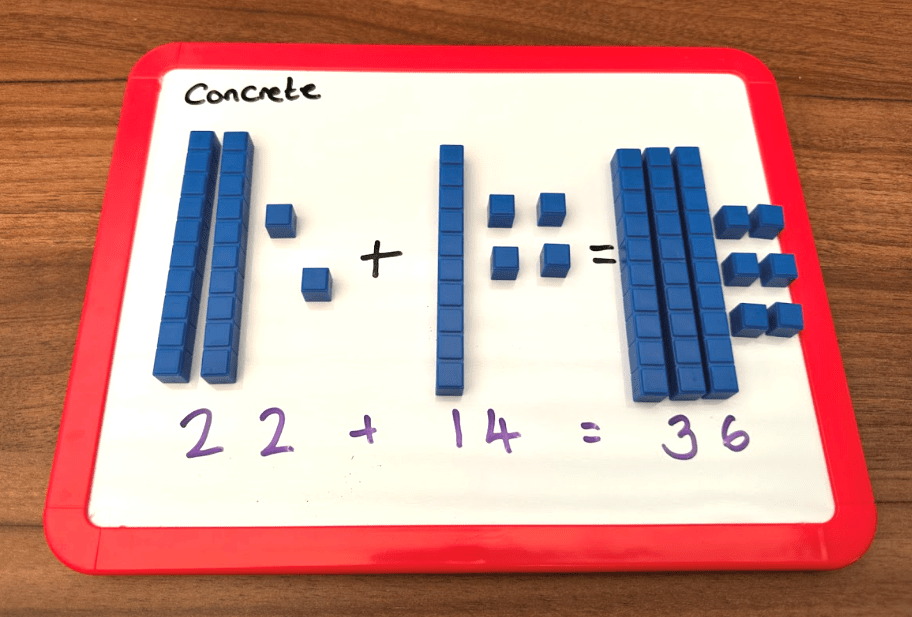
Make it visible. For pupils with dyscalculia, abstract symbols can feel disconnected from meaning. Visual tools and concrete materials help to bridge that gap. Using number lines, base ten blocks, dot patterns, bar models, or Cuisenaire rods allows pupils to see the structure of number. These tools are not just for early years or intervention groups—they remain valuable right through primary and beyond. The Concrete–Pictorial–Abstract (CPA) approach is key here. Pupils need time to explore mathematical ideas using physical objects and visual models before being expected to work with abstract symbols. Returning to concrete representations is not a sign of weakness. It’s a route to understanding.
Talk it through. Many pupils with dyscalculia benefit from talking aloud as they work. This verbalisation helps reduce working memory load and clarify thinking. Encouraging pupils to explain how they solved a problem, even if they are unsure of the answer, can provide insight into their reasoning and misconceptions. Maths journals, discussion prompts, and sentence stems can all support pupils to express their thinking in words. Giving space for talk also helps to demystify maths. It moves the focus away from getting the answer quickly and towards understanding the process.
Build from what they know. Instead of expecting instant recall, help pupils build strategies that start with what they do know. If a pupil knows that five plus five is ten, can they use that to work out six plus five? If they know that three fours are twelve, can they reason that six fours must be double that? Teaching strategy-based approaches supports pupils in becoming flexible thinkers. It also gives them confidence that there is more than one way to reach an answer. Fluency, in this sense, is not about memorising isolated facts, but about developing connections between them.
Reduce the load. Many pupils with dyscalculia experience cognitive overload in maths lessons. Tasks that involve multiple steps, too much information on the page, or tight time constraints can become overwhelming. Small changes can help. Present one problem at a time. Use consistent layout and language. Reduce visual clutter. Provide processing time without pressure. Offer tools like number lines, times table grids, or even calculators if the goal is reasoning, not recall.
These adjustments do not lower expectations. They remove unnecessary barriers so pupils can focus on the mathematics itself. Crucially, they are not only for classroom teachers. Anyone supporting a pupil with mathematical difficulties, whether in a teaching role, intervention session, or one-to-one support, can implement these approaches. When we shift our focus from performance to understanding, we create a more inclusive environment for every learner.
Recognising dyscalculia can be difficult. There is no single test or checklist that provides certainty, and formal diagnosis often requires input from an educational psychologist or specialist assessor. But a lack of diagnosis does not mean we should wait to act. Educators are in a powerful position to notice the signs early. A pupil who relies on finger counting long after others have moved on, who seems unable to estimate whether an answer makes sense, or who avoids maths tasks altogether, may be showing signs of dyscalculia. These indicators are not about effort or attitude; they reflect a different way of processing number. Tools like the Dyscalculia Checklist or informal number sense screeners can help identify patterns of difficulty. More importantly, they can prompt conversations. Is this pupil making progress in other subjects but persistently stuck in maths? Do they grasp the How but never the Why? Are they using inefficient strategies over and over again?

Responding does not have to mean overhauling an entire curriculum. It starts with small changes: offering extra time to think, revisiting key concepts with visual models, or providing structured opportunities to explain thinking aloud. Pre-teaching vocabulary, using familiar representations, and linking new ideas to secure facts can make a meaningful difference. These changes are not just the responsibility of the classroom teacher. Teaching assistants, learning support staff, SENCOs, and subject leads all play a role in shaping how pupils experience maths. Whole-school awareness matters. When everyone understands what dyscalculia is—and what it is not—pupils are more likely to receive consistent, informed support.
Most importantly, we can begin with belief. Belief that the pupil is trying. Belief that progress is possible. And belief that changing how we teach can change how they learn.
Shifting the focus
Too often, pupils with dyscalculia are seen through the wrong lens. They are described as slow, weak, or simply behind. Their difficulties are attributed to poor memory, lack of effort, or gaps in learning. But when we understand dyscalculia for what it is—a specific learning difficulty rooted in how number is processed—we can begin to respond differently.
Supporting these pupils does not require a specialist title or a formal diagnosis. It requires curiosity, flexibility, and a willingness to step back and ask a better question. Instead of Why don’t they get it? we might ask How are they making sense of this? And rather than repeating the same strategies more often, we can offer different ones.
Reframing fluency is part of that change. If we stop equating fluency with recall and speed, and start valuing flexibility, reasoning, and sense-making, we open up maths for more learners. We reduce anxiety. We build confidence. And we send a powerful message: that understanding matters more than speed, and progress matters more than perfection.
The role of educators, across every setting and every role, is not just to teach content. It is to notice, to adapt, and to create conditions in which all pupils can learn and thrive. For those with dyscalculia, that shift can be transformative. It starts not with diagnosis, but with understanding.


Author: Jon Cripwell


Jon Cripwell
Jon Cripwell is the National Education Lead for Primary Maths at Twinkl. He's an NCETM-accredited maths specialist and former Assistant Headteacher.
Website: twinkl.co.uk