






















Circadian misalignment is a hidden barrier to neurodivergent attendance and emotional regulation, explains Zoe Aspinall.
Every September, schools prepare to welcome pupils back with new timetables, new routines and new expectations. Yet one element rarely changes: the early start. For many adolescents, this is challenging but manageable. For neurodivergent pupils, however, an early start can quietly become one of the most significant neurological accessibility barriers in the entire school day.
We are quick to label this difficulty as Motivation, Avoidance or even School Refusal, but when you look closely at the neuroscience a different story emerges—one that reframes attendance, behaviour and emotional regulation through a neurobiological lens rather than a behavioural one.
Over the last decade, research has repeatedly demonstrated that adolescents experience a natural delay in their circadian rhythm. There is a shift in circadian neurobiology: melatonin is released later, sleep pressure builds differently, and the brain’s transition from sleep to wakefulness becomes slower. In practical terms, the neural systems responsible for attention, emotional regulation and executive functioning simply come online later. This is not a lifestyle issue, and it is not a matter of poor habits. It is a normal developmental process observed across cultures, climates and socioeconomic groups.
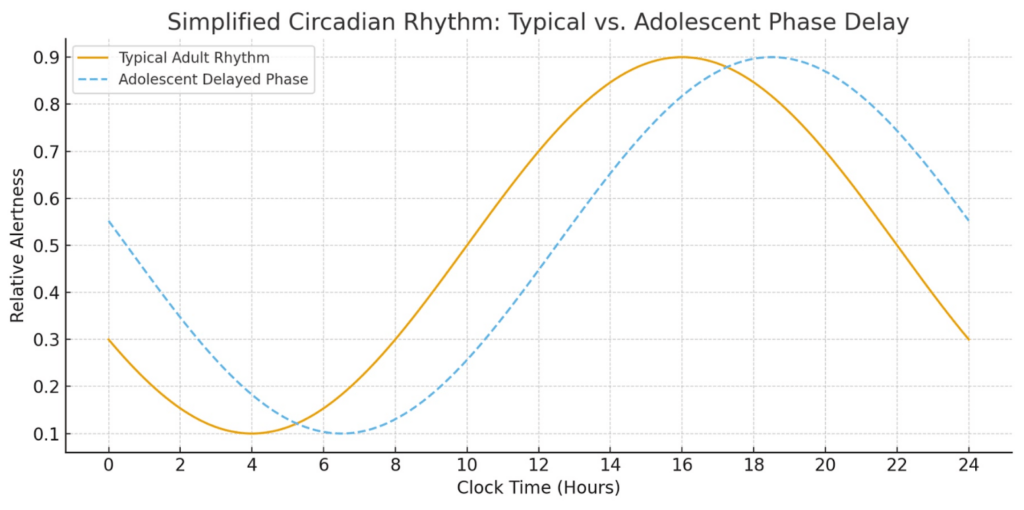
For many neurodivergent young people, the circadian shift is amplified by differences in sensory processing, arousal regulation and prefrontal functioning. ADHD, autism and certain learning profiles all intersect with circadian neurobiology, influencing everything from sleep onset and maintenance to morning alertness. A nervous system that is still transitioning from its overnight regulatory state can be more sensitive, more reactive and less able to filter incoming information. The world feels louder, brighter, faster and harder to organise—just at the moment when school expects social ease, cognitive flexibility and emotional control.
When schools interpret the resulting dysregulation as challenging behaviour, relationships strain on all sides. But the moment we recognise this as neurobiology in conflict with system design, our understanding of attendance and behaviour changes entirely. If a pupil’s brain is still in its biological night mode, the school day begins before they’re neurologically awake. What may look like reluctance is frequently just mis-timed neural readiness.
For many neurodivergent pupils, mornings can be experienced as a neurophysiological traffic jam. Their sensory system is louder. Their emotional regulation is thinner. Their prefrontal cortex—the part of the brain responsible for planning, impulse control and social interpretation—is still warming up. Social interpretation, already shaped by different neurotypes and expectations, becomes harder when the system demands more than the nervous system can offer at that time of day. As internal resources run low, even small moments of unpredictability can feel amplified, simply because the environment is out of sync with the pupil’s neurocognitive readiness.

In practice, circadian misalignment shows up in familiar ways: the young person who can’t face the noise of the corridor; the pupil who enters in a state of overwhelm despite “nothing having happened yet”; the teenager who appears oppositional during morning tutor time but settles by late morning; the learner whose attendance collapses despite supportive home routines. Families often see their child manage far better later in the day, or during weekends, or in environments that offer flexibility and predictability.
When we examine these patterns through the lens of neurological accessibility rather than compliance, the barrier becomes clear. Early start times don’t simply challenge motivation; they collide with neurophysiology. And when the environment demands more cognitive, emotional and sensory capacity than the nervous system can provide at that time of day, the result is cumulative: anxiety increases, behaviour escalates, relationships deteriorate and attendance declines.
This is one of the reasons punitive or behaviourist responses so often fail. They attempt to correct the presentation of choice when the underlying reality is a neurobiological mismatch. Students cannot be rewarded or sanctioned out of a circadian phase shift. Nor can they be coached into trying harder when their neural systems are fundamentally unprepared. What they need is access, and access means first understanding the barrier and then removing it.
A circadian-informed approach doesn’t require redesigning the entire timetable overnight. It begins with recognising that morning cognitive load is not equally available to all learners and that some pupils, especially neurodivergent ones, may require a different route into neural readiness. Schools already know that pupils have varied cognitive peaks, sensory thresholds and regulatory profiles. Circadian neurobiology simply adds a layer that has been historically overlooked.
When schools begin to think ecologically—considering how space, time, sensory load, predictability and human interaction combine to shape a pupil’s neurocognitive experience—they often discover that a few targeted adjustments have a disproportionately positive impact. The first step is shifting from a behaviour-first to a neurology-first mindset. Instead of asking Why won’t they come in?, we ask What does their nervous system need in order to access this part of the day? This question alone changes practice.

Across the UK, there is growing interest in how circadian-informed approaches might support attendance recovery, calmer starts and more stable emotional regulation, particularly for pupils whose neurotype interacts closely with sleep-wake timing. International research shows clear links between circadian alignment and improved well-being, engagement and executive functioning in adolescents. Early exploratory work in several countries suggests that when school systems make space for the brain’s timing rather than fighting it, pupils often experience a smoother, calmer entry into learning.
The aim is not to remove expectations or avoid challenge. The aim is to design school systems that do not generate avoidable neurocognitive barriers, especially for pupils whose neurology interacts dynamically with timing, predictability and processing load. This is the essence of neurological accessibility—aligning environments and governance with the functioning of the nervous system rather than expecting the nervous system to continually compensate for the environment.
Circadian rhythm is one piece of a much larger accessibility puzzle, but it is one that has been largely absent from attendance strategy, behaviour policy and pastoral intervention. Bringing it into the conversation offers schools a new, evidence-informed way to understand experience—one that can prevent difficulties long before they escalate into crisis.
The full methodology extends beyond what I’ve mentioned here. It includes ecological analysis, system-level review, governance alignment and detailed mapping of the interactions between time, sensory load and neural readiness. But if the conversation begins here, with an understanding that neuroscience shapes behaviour, then schools can begin to make adjustments that restore dignity, reduce conflict and support the pupils who are often the most misunderstood.
For many neurodivergent young people, the issue is not that they cannot engage. It is that they are being asked to engage at a time when their neural systems are least able to do so. Once we recognise that, we can begin to design school days that work with their neurology rather than against it. And when we do, the impact on attendance, emotional well-being and learning access can be profound.

Author: Zoe Aspinall

Zoe Aspinall
Zoe Aspinall is a specialist in neurological accessibility and ecological inclusion, and the founder of NeuroInclusive.UK Community Interest Company, which supports schools, trusts and local authorities to harness applied neuroscience.